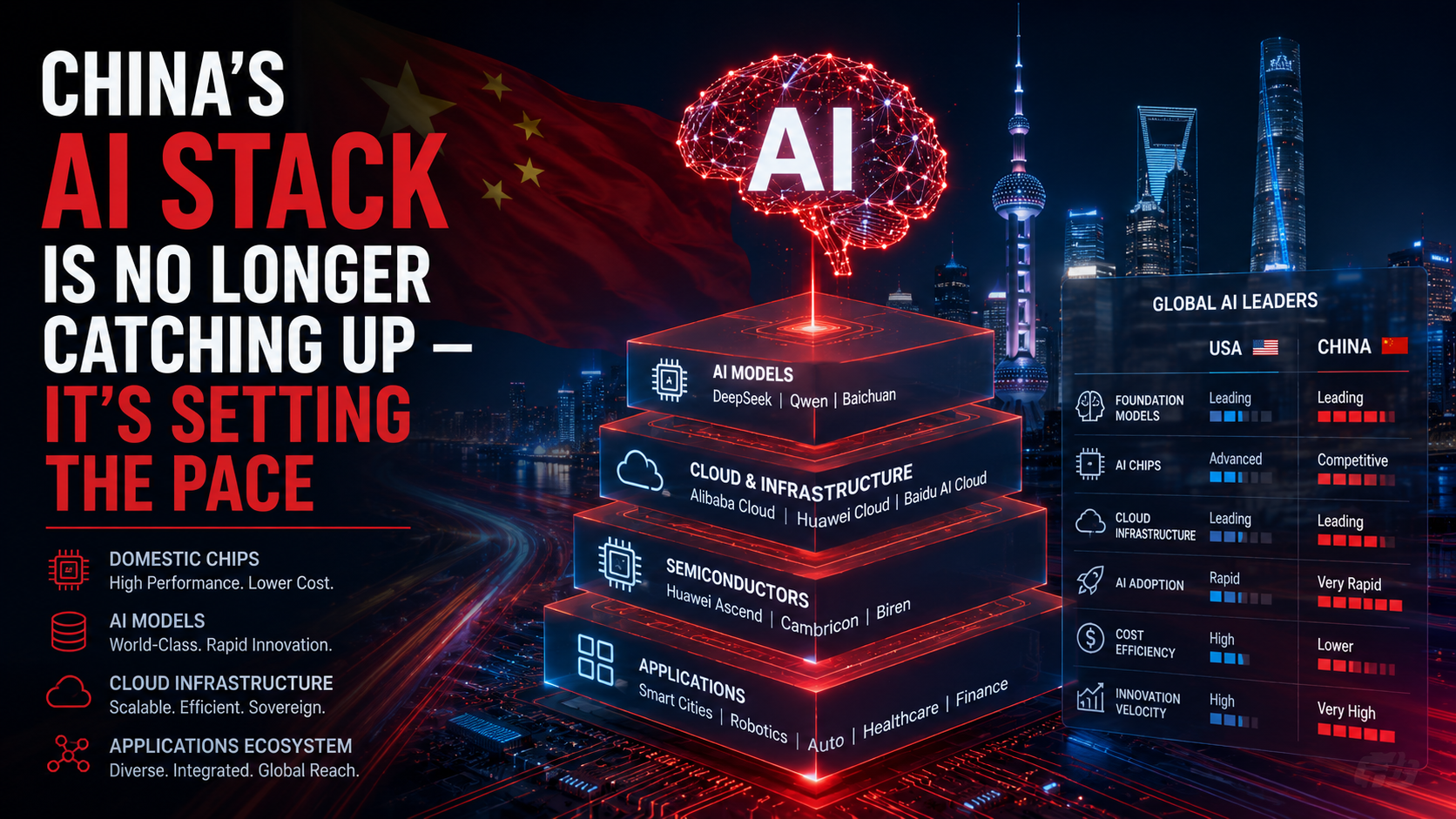
China's AI Infrastructure Now Rivals Silicon Valley With DeepSeek V4 and Huawei's SuperPoD Ecosystem
- China's daily AI token consumption has grown from roughly 100 billion to 140 trillion, with all six top-ranked global models on OpenRouter being Chinese by early April 2026.
- DeepSeek V4 and Huawei's Atlas SuperPoD product were co-designed, delivering up to 1.96x performance gains on latency-sensitive workloads and marking the first simultaneous chip-model launch between a Chinese AI firm and hardware manufacturer.
- Huawei's CANN framework went fully open-source in 2025, generating 65 new open-source projects and more than 3,000 monthly active developers within five months.
According to usage data tracked on OpenRouter across March and April 2026, Chinese large language models consistently ranked first globally in weekly token consumption for multiple consecutive weeks. In the week of March 9, Chinese model companies claimed the top two spots in the platform's monthly statistics for the first time. By early April, all six of the top-ranked global models were Chinese.
China's daily token consumption has grown from roughly 100 billion to 140 trillion — a scale that positions AI as infrastructure rather than a demonstration project, comparable in reach to electricity or broadband. Token consumption functions as a proxy for economic integration, reflecting enterprise workflow automation, developer tooling, and consumer product enhancement feeding back into model improvement.
The release of DeepSeek V4 marked a significant infrastructure milestone when Huawei announced full support for the model at the same moment it launched. DeepSeek V4 and the Atlas SuperPoD product were co-designed, with the model's fine-grained Expert Parallel architecture built with the hardware in mind from the start. As stated in Section 3.1 of DeepSeek's technical report: 'We have verified this fine-grained expert parallel scheme on both the NVIDIA GPU and Huawei Ascend NPU platforms.'
The co-design approach delivers a 1.5x to 1.73x performance improvement on the Atlas SuperPoD product, with gains reaching up to 1.96x on latency-sensitive reinforcement learning rollouts. The scheme splits mixture-of-experts (MoE) experts into waves and continuously overlaps computation, dispatch, and result-sending.
Huawei's Atlas 950 SuperPoD supports up to 8,192 cards interconnected via its UnifiedBus interconnect, delivering ultra-high bandwidth, ultra-low latency, and unified memory addressing across the entire cluster. Unified memory addressing means the software does not need to explicitly manage address mapping for data transmission between nodes, allowing the cluster to function as a single large-memory system — which is precisely what MoE architectures require at scale. It is currently the only AI SuperPoD in China to have achieved large-scale commercial deployment.
The TaiShan 950 SuperPoD extends this architectural logic to general-purpose computing, introducing terabyte-level interconnect bandwidth, hundred-nanosecond-level latency, and memory pooling that enables cross-node data transfer via memory semantics. This addresses long-standing challenges of high latency, data movement overhead, and coordination inefficiency in general compute workloads.
Huawei's software framework CANN (Compute Architecture for Neural Networks) went fully open-source in 2025. In the five months since, 65 open-source projects have launched in the community — roughly one new project every three days. Monthly active developers now exceed 3,000.
CANN supports Ascend C and PyPTO, and is compatible with major programming frameworks including Triton and TileLang. More than 70 mainstream models work out of the box, the library includes more than 1,500 basic operators and more than 100 fusion operators, and the system is integrated with more than 90 open-source communities.
China's AI stack — spanning the Atlas 950 SuperPoD and TaiShan 950 SuperPoD at the infrastructure layer, the CANN open-source framework, and models such as DeepSeek V4 — now constitutes an end-to-end, domestically innovated ecosystem. The chip-to-model closed loop that the industry once assumed only NVIDIA and its partners could provide is no longer exclusive.