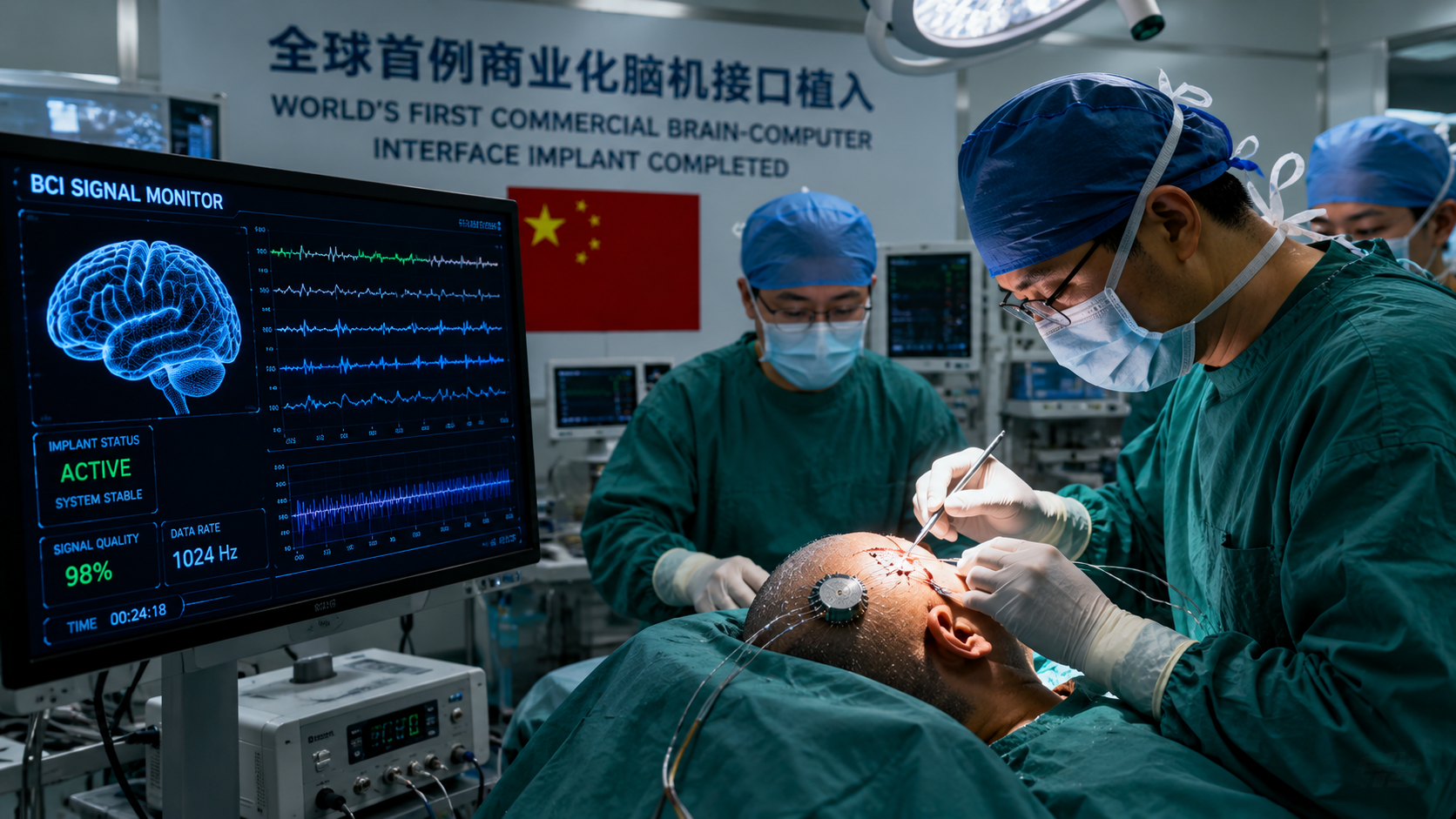
China Performs World's First Commercial Brain-Computer Interface Surgery, Challenging Neuralink
- China completes the world's first commercial brain-computer interface implant, marking a major milestone in neurotechnology.
- The implant allows paralyzed patients to control digital devices using brain signals, expanding real-world BCI applications.
- The breakthrough intensifies China's competition with Neuralink and strengthens its position in the global brain-computer interface race.
Chinese surgeons implanted a coin-sized brain chip on a patient with impaired hand mobility linked to a spinal cord injury from a car accident 10 years ago, according to a statement from the Science and Technology Commission of Shanghai Municipality on Wednesday.
The procedure, performed on Monday at Huashan Hospital, captured stable, high-quality epidural brain signals, with the patient recovering and vital signs remaining stable.
Developed by local start-up Neuracle Medical Technology, the NEO device assists hand motion. It is placed on the brain’s outer surface without penetrating tissue, reading neural signals and translating them into hand movements.
It became the world’s first commercially prescribed BCI after winning approval from China’s National Medical Products Administration on March 13, making it available as a commercial product rather than confined to laboratories and clinical trials.
ince clearance, NEO had rolled out production, hospital introductions, patient screening and inclusion in local commercial health insurance within four months, according to the statement.
The milestone underscores China’s ambition to lead the global BCI race, which it has identified as one of the future industries driving economic growth, with plans to cultivate “two or three” global leaders by 2030.
A government blueprint last July set targets for key breakthroughs by 2027, including building an advanced technology system and industrial framework.
Shanghai-based Neuracle began its Star Market listing process in February to bolster resources for research and production.
By contrast, Musk’s Neuralink has yet to secure full commercial approval from the US Food and Drug Administration, though it has enrolled more than 20 patients in trials for its first product, Telepathy. The system aims to enable people with paralysis to directly control devices including computers, phones and robotic limbs.