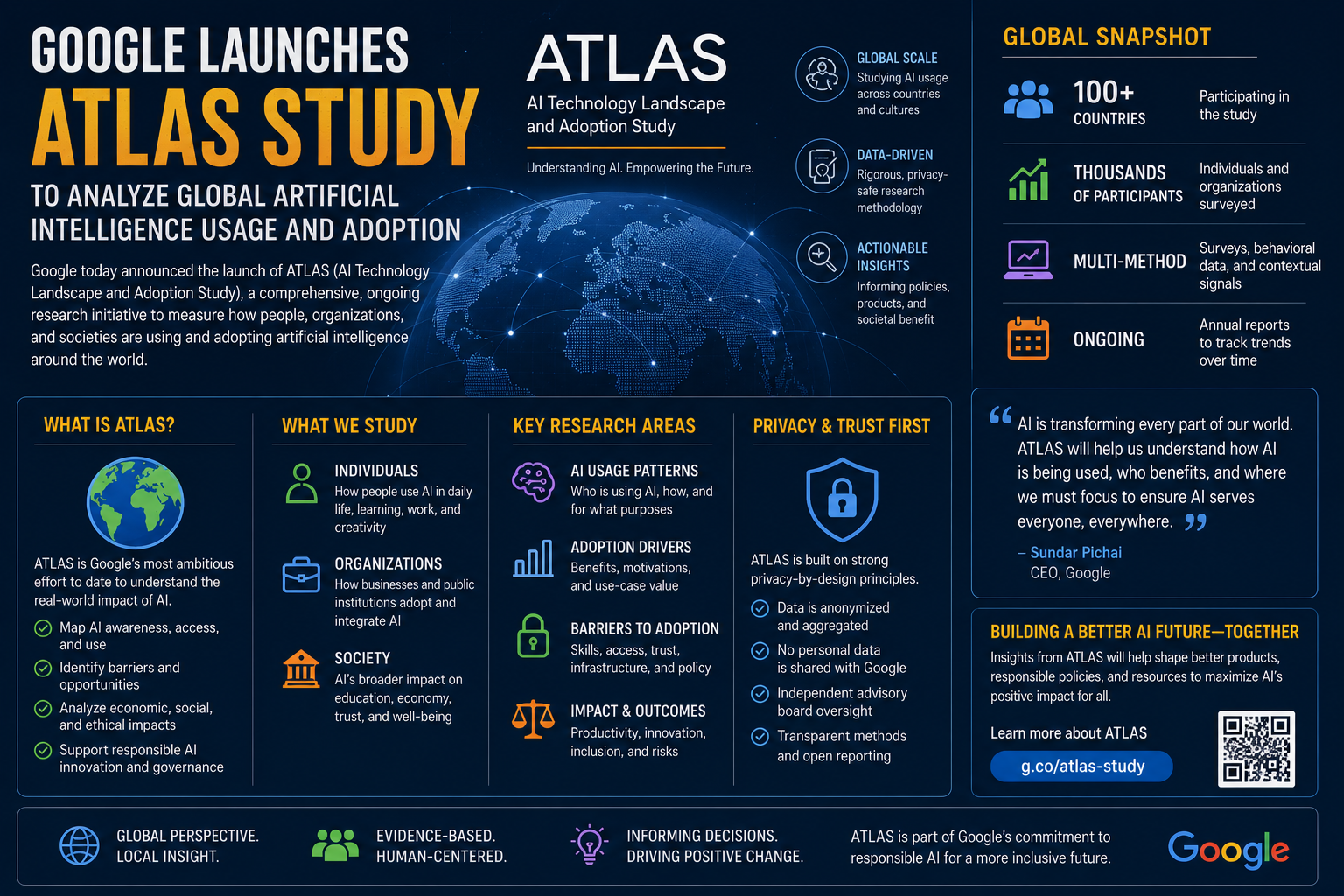
Google Launches ATLAS Study to Analyze Global Artificial Intelligence Usage and Adoption
- Google launched the ATLAS study using 15 million interactions to analyze artificial intelligence usage across 150 countries and 800 occupations.
- Workplace usage spans 68% of occupations, but employees apply artificial intelligence to only 21% of job tasks on average
- Over 86% of interactions occur outside of work for household, administrative, and government service tasks.
The ATLAS v1.0 dataset evaluates 15 million aggregated, de-identified human interactions across the Gemini App, AI Mode, and the Gemini API. These platforms are utilized monthly by more than 1 billion people worldwide.
The study spans over 150 countries, 140 languages, 800 occupations, and 4,000 tasks. Insights are generated using Google DeepMind Observation Clustering and Taxonomy Organisation technology to classify unstructured text data.
Workplace adoption covers 68% of all occupations representing 90% of total U.S. employment. However, artificial intelligence is used selectively within jobs, accounting for approximately 21% of tasks in a typical position.
Most work interactions focus on collaboration, strategy, information retrieval, and learning, with task automation comprising less than 10% of workplace use. Non-routine cognitive tasks like creative design represent 65% of work interactions.
Workers in manual trades, such as auto technicians and industrial mechanics, use conversational tools for real-time diagnostics and troubleshooting. These trade workers are 2x more likely to use multimodal tools to create images or video.
More than 86% of interactions in the study occur outside of work. Personal usage focuses on household activities, appliance assistance, product research, and administrative tasks like navigating government services, taxes, licensing, and fines.
English accounts for approximately one-third of global conversations within the dataset. Per-capita usage closely mirrors national wealth levels, though select middle-income countries in South America and the Middle East show adoption rates comparable to higher-income nations.