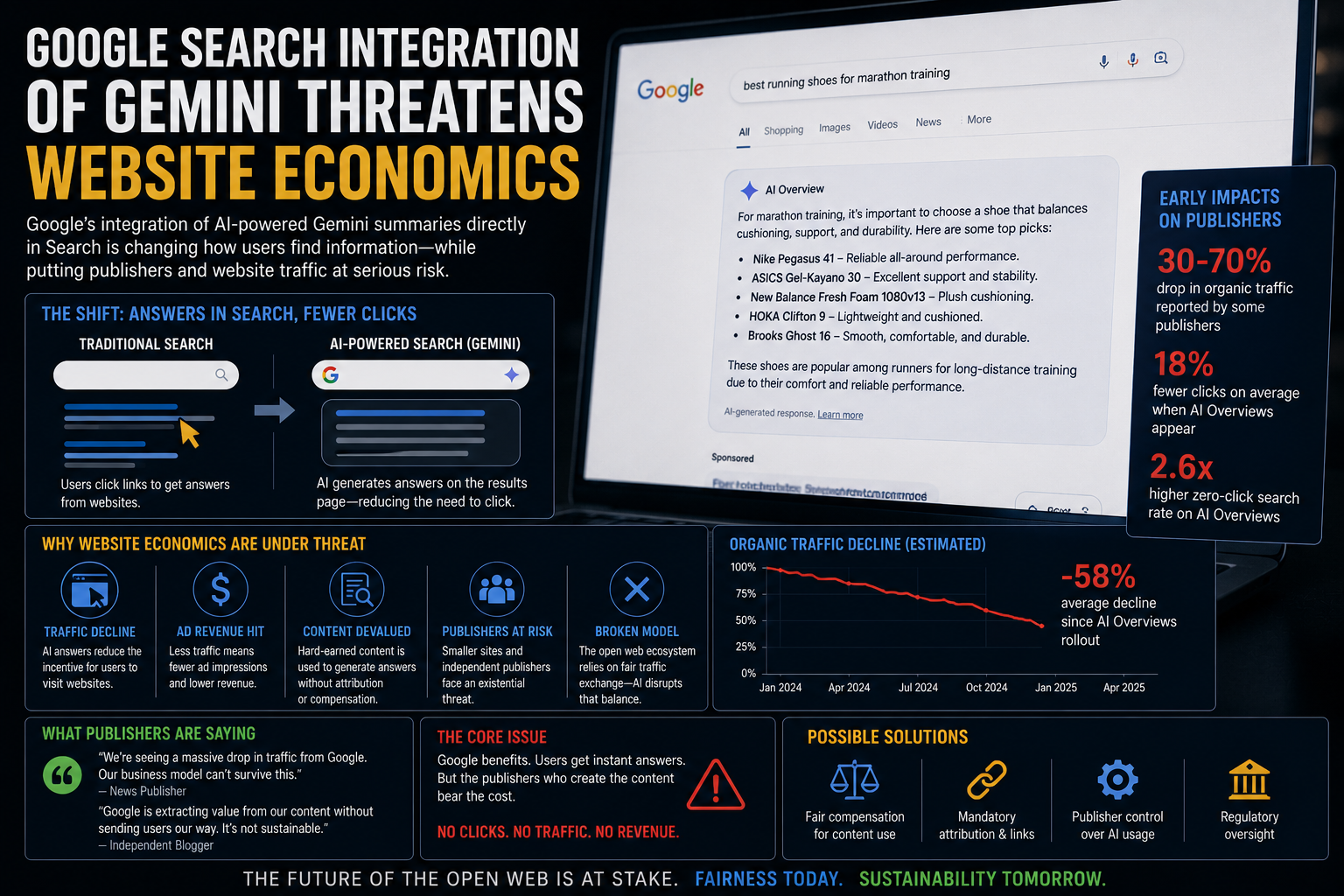
Google Search Integration of Gemini Threatens Website Economics
- Google integration of artificial intelligence into search reduces human visitor traffic to original content websites.
- Human traffic to finance, publishing, and retail sites fell nearly 40% while bot traffic grew to half of all web traffic.
- Organizations such as Wikipedia are shifting to mobile apps and social media to maintain direct relationships with audiences.
As artificial intelligence generated answers increasingly replace traditional search results, websites are seeing fewer visitors arriving from Google. This brings closer the scenario known as Google Zero, which is the point at which search traffic sent to publishers and other websites approaches zero.
For more than a quarter of a century, Google Search has driven users to news outlets, content platforms, shopping sites, and businesses. In recent years, its importance grew further as platforms such as Facebook reduced the visibility of news and political content in feeds.
Google launched AI Mode to provide users with answers generated by Gemini at the top of search results. The company later expanded those capabilities by redesigning the search experience and introducing agents capable of carrying out autonomous searches.
According to Google, artificial intelligence related queries are three times longer than traditional search queries. Users also spend between one and nine additional minutes on pages containing artificial intelligence generated results.
Data released by Cloudflare showed that human traffic to websites in industries including finance, publishing, and retail declined by nearly 40% between June 2025 and April 2026.
Bot traffic increased during the same period and now accounts for around half of all online traffic. Bots consume content without clicking advertisements, subscribing to services, or purchasing products.
Wikipedia has seen human traffic decline by 8%, while the number of bots collecting information from the site has increased. The organization has begun promoting its mobile app and expanding its presence on social media to build direct relationships with users outside the ecosystem of Google.