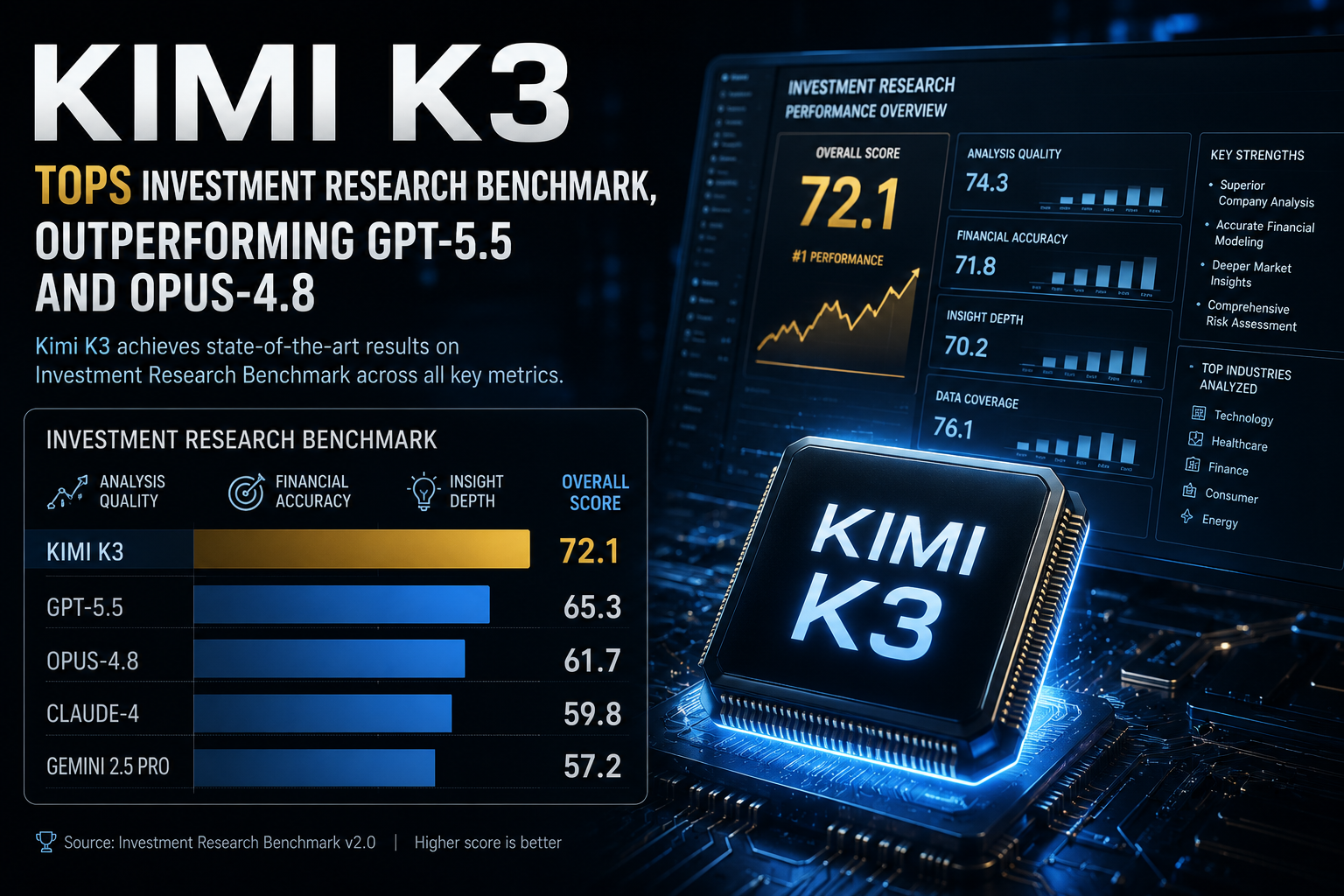
Kimi K3 Tops Investment Research Benchmark, Outperforming GPT-5.5 and OPUS-4.8
- Kimi K3 outscored GPT-5.5 and OPUS-4.8 on AlphaEngine's proprietary IRB benchmark across temporal judgment, evidence boundary control, and premise correction.
- In a bond market timing task, K3 scored 94.3 points by anchoring analysis to current DR001 rate data ranging from 1.35% to 1.40%, rather than averaging all available figures.
- AlphaEngine has deployed Kimi K3 on its platform, giving institutional users access to the model's investment reasoning capabilities alongside other frontier models.
The evaluation used AlphaEngine's proprietary Investment Research Benchmark framework, developed by Shanghai Shangjian Technology, to test models against real investment research challenges that have historically caused analyst errors and model failures. K3 achieved significant score advantages over GPT-5.5 and OPUS-4.8, while matching Anthropic Fable 5 in long-context modelling and historical review dimensions.
In a stock price anomaly attribution task where definitive evidence was unavailable, K3 scored 88.3 points by acknowledging the evidence gap rather than fabricating causality. It then used three verifiable indirect signals — valuation premium, capital structure, and sector rotation — to construct a reasonable attribution framework, demonstrating the kind of reasoning discipline expected of a production-grade investment model.
In a bond market timing task involving conflicting data, K3 scored 94.3 points by anchoring to the latest DR001 rate data, which showed a shift from extreme lows to between 1.35% and 1.40%. The model explicitly distinguished between marginal tightening and full liquidity tightening, refusing to allow outdated figures to distort its conclusions.
A premise correction scenario tested the model's ability to identify user error. Where a query contained an erroneous 0.76% net profit margin figure, K3 first verified the original financial statement — finding a negative net profit attributable to the parent company — before correcting the premise rather than generating explanations based on the mistaken figure.
An A-share bull market phase analysis task assessed multi-framework integration. K3 compressed the bull market cycle into a three-phase framework covering valuation recovery, capital positive feedback, and earnings delivery, identified where the current market stood within that structure, and translated the analysis into specific portfolio actions.
AlphaEngine has already integrated Kimi K3 into its platform, allowing institutional users to access K3's investment research reasoning alongside existing models. The benchmark identifies a clear trade-off: K3 excels in reasoning discipline and evidence boundary handling, while Fable 5 retains advantages in certain creative and open-ended analytical tasks.